Best Bangkok Tours: Food, Floating Markets, Dinner Cruises & Night Adventures (2026)


Bangkok is one of those cities that just gets under your skin. Not in a subtle way either.
It’s loud and golden and chaotic and incredible, and somehow everything smells like either jasmine or pad thai depending on which alley you’ve wandered into.
I came here thinking I’d spend a few days, and ended up staying almost two weeks trying to see as much as I possibly could.
The thing about Bangkok is that it moves fast. The streets twist in ways that don’t make sense on a map, the traffic operates by its own mysterious logic, and the best food is often tucked into corners you’d walk past without a second glance.
Tours changed everything for me here. Not the stiff, follow-the-umbrella kind, the good ones, where a local actually shows you how the city works.
Whether you’re into floating markets at dawn, street food crawls through Chinatown, gliding along the Chao Phraya River at night, or learning to make green curry from scratch, Bangkok has a tour for it.
This guide breaks down the best types of Bangkok tours so you can figure out which ones actually match what you’re looking for. Each section links through to a detailed review where you can dig into the specifics before you book anything.
Why Taking a Tour in Bangkok Makes Travel Easier
I’ll be honest, I tried doing Bangkok solo on my first full day and it did not go smoothly.
I spent forty minutes trying to find a market that turned out to be a ten-minute walk away, got on the wrong river ferry twice, and ended up eating at a tourist trap near Khao San Road because I had no idea where else to go. It happens to everyone.
Bangkok is genuinely complex in a way that a lot of cities aren’t. The streets in the older neighborhoods don’t follow a grid. Menus at local spots are sometimes only in Thai.
The best street food stalls don’t have signs in English, and they’re not necessarily on the main road, they’re down a side alley that looks like it leads nowhere. Traffic across the city can be brutal, especially if you’re trying to get from one neighborhood to another mid-afternoon.
A good guided tour cuts through all of that. Your guide knows which stall has been making the best boat noodles for thirty years.
They know which floating market is worth the early wake-up and which one is mostly selling refrigerator magnets to tourists. They handle the logistics so you can just be present and enjoy it. That’s genuinely valuable in a city this layered.
Best Types of Bangkok Tours
Bangkok doesn’t really do one-size-fits-all. Some people want to be on the water at sunrise. Some want to eat their way through six neighborhoods in one evening.
Some want to come home knowing how to actually cook Thai food. The city handles all of it. Here’s a look at the main experiences worth considering.
Bangkok Floating Market Tours

The floating markets outside Bangkok are one of those experiences that genuinely live up to the pictures, but only if you go to the right one.
Damnoen Saduak is the most famous, about an hour and a half southwest of the city, and it’s easy to see why it became iconic, wooden boats loaded with tropical fruit, women in wide-brimmed hats, canals lined with vendors selling grilled corn and mango sticky rice. It’s real, even if it’s also busy.
Amphawa is a different vibe. Smaller, less visited, more local. The weekend floating market there comes alive in the afternoon rather than at sunrise, and the canal-side seafood is exceptional. If you have the flexibility to choose, Amphawa feels more like you’ve actually found something.
Timing matters a lot with floating markets. Go early. By mid-morning at Damnoen Saduak the crowds are thick and the atmosphere shifts. The best light, the best energy, and the best photo opportunities are all in that first hour after the market opens. A guided tour gets you there at the right time without you having to figure out transportation from Bangkok yourself.
If you want the full breakdown of what to expect, what to eat, and which market suits which type of traveler, the detailed guide to Bangkok floating market tours covers all of it.
Bangkok Food Tours

Eating in Bangkok is not a passive activity. It’s something you plan around, talk about constantly, and think about the next morning. The city has one of the most complex and exciting street food cultures in the world, and it’s spread across neighborhoods in ways that take a while to figure out.
Chinatown, Yaowarat Road and its surrounding streets is the obvious starting point. It’s dense with vendors, noodle shops, barbecue stalls, and dessert spots that have been open for generations. But Bangkok’s food scene extends well beyond that. The night markets around Lat Phrao pull serious local crowds.
The family-run spots in Thonburi serve dishes you won’t easily find on the tourist trail. The hidden alleys around the old city have lunch counters with plastic stools and menus that rotate daily depending on what came in fresh.
A food tour is genuinely one of the better uses of a night in Bangkok. A good guide brings you to the spots they actually eat at, explains what you’re looking at, and keeps the pacing right so you’re still hungry when the next stop arrives. It’s the fastest way to understand how Bangkok eats.
For specific tours, what they cost, and what you’ll actually taste, the full guide to Bangkok food tours has everything you need.
Dinner Cruises in Bangkok

The Chao Phraya River runs through the heart of Bangkok and at night it becomes something completely different from the busy commuter waterway it is during the day.
The temples along the bank light up. Wat Arun, the Temple of Dawn, somewhat confusingly, glows white and gold from the water. The city skyline stretches out behind it. It’s a side of Bangkok that a lot of visitors never actually see because they’re stuck in traffic somewhere inland.
A dinner cruise puts you on the river for a couple of hours with a buffet meal and that whole glittering panorama sliding past. The food varies a lot depending on which boat you choose, some offer solid Thai and international spreads, others are more about the atmosphere than the cuisine. Either way, the setting does a lot of the work.
It’s a good option for a night when you want something relaxed and scenic rather than another evening of exploring on foot. Families travel well on these. So do couples. The vibe is easy and the views are genuinely worth it.
Everything you need to know about choosing the right boat and what to expect on board is in the detailed guide to Bangkok dinner cruises.
Thai Cooking Classes in Bangkok

A Thai cooking class is one of those experiences that sounds like a nice idea and turns out to be genuinely one of the best things you do on the trip. I say that having taken one somewhat skeptically and come out completely converted.
Most classes start with a market visit. Your instructor walks you through the ingredients, galangal versus ginger, the different varieties of basil, why fish sauce is the backbone of almost everything. That context matters when you get to the cooking part. You’re not just following steps, you’re starting to understand why Thai food tastes the way it does.
From there you cook. Pad thai, som tum, massaman curry, green curry, tom kha, it depends on the class, but you’ll typically make three to five dishes and then eat all of them. The curry pastes are the revelation. Pounding a green curry paste from scratch in a mortar, understanding what goes in and why, is the kind of thing that permanently changes how you cook at home.
The skill transfers. That’s what makes cooking classes different from most tour experiences. You take something home with you that isn’t a souvenir. The full guide to Thai cooking classes in Bangkok compares the top schools and explains what a half-day class actually looks like from start to finish.
Bangkok Night Tuk Tuk Tour

Bangkok at night is a different city. The heat drops just enough to be comfortable, the temples switch on their lights, and the streets around the old city take on this golden, slightly surreal quality that’s hard to describe until you’ve seen it. A tuk tuk tour is the right way to move through it.
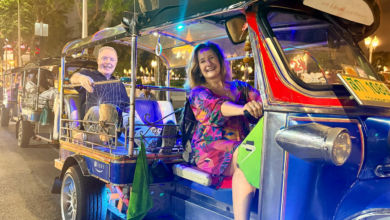
You’re open to the air, which means you actually feel the city rather than watching it through a window. The driver threads between lanes, cuts down alleyways, pulls up in front of Wat Pho so you can step out and stare at it properly.
Most tours include street food stops along the route, mango sticky rice from a cart, fresh-squeezed juice, maybe a stop at a late-night noodle spot the guide actually recommends rather than just the one closest to a main road.
It’s fun in a way that’s hard to replicate. Tuk tuks are inherently silly and also genuinely exhilarating, and doing it at night with someone who knows where they’re going rather than just hoping for the best is a completely different experience from flagging one down yourself outside the Grand Palace.
The full rundown on what to expect, which routes cover the most ground, and how to book is in the guide to the Bangkok night tuk tuk tour.
Bangkok Tuk Tuk Food Tours

If you want to combine the thrill of the ride with serious eating, a tuk tuk food tour is the version of Bangkok nightlife that’s genuinely hard to beat.
The format makes sense once you’ve navigated the city a little. Bangkok’s best food is spread across neigh
borhoods that don’t connect cleanly on foot, and traffic makes conventional transport a patience-testing experience after dark. A tuk tuk solves both problems. You’re moving between districts quickly, you’re open to the air, and somehow the food tastes better when you’ve arrived with the wind in your face and the city lights blurring past.
Most tours run three to four hours and hit four to five stops across different parts of the city. The serious options go deep into Chinatown along Yaowarat Road, pull up at hidden alley spots near the old city, and often finish at something unexpected, a rooftop bar overlooking Wat Arun, or the 24-hour Pak Khlong flower market in full swing at midnight.
The food itself covers the range: charcoal-grilled noodles, E-San dishes, mango sticky rice, and street food staples from vendors who’ve been at the same corner for decades.
The format varies more than you’d expect across operators. Some tours prioritize Michelin-cited restaurants and cap groups at eight for a more considered experience.
Others lean into the midnight energy, larger groups, and the social atmosphere that comes with that. A handful offer hotel pickup directly to your lobby, which changes the logistics entirely if you’re not comfortable navigating to a BTS station at night.
Guide quality matters more on a tuk tuk food tour than on almost any other Bangkok experience. When the guide knows the food and knows the city, the stops feel purposeful and the explanations actually add something.
When they don’t, five neighborhoods of street food can start to feel like a list being ticked rather than a city being understood.
For a full comparison of the top options, what each one costs, and which format suits which type of traveler, the complete guide to Bangkok tuk tuk food tours covers all of it.
How to Choose the Right Bangkok Tour
The easiest way to narrow it down is to think about time of day first. Floating markets are a morning commitment, you’re looking at an early start and you’ll be back by early afternoon.
Food tours work best in the evening when the street food scene is fully alive. Dinner cruises are obviously an evening experience. Cooking classes typically run in the morning or afternoon. Tuk tuk tours are at their best after dark.
After that, think about what kind of energy you have for the trip. If you’re traveling with someone who isn’t big on physical activity, a dinner cruise is a gentle, scenic option that doesn’t require much walking.
If you’re the kind of traveler who eats their way through every city, a food tour is almost non-negotiable. If you’re here for a week or more, a cooking class is worth building half a day around.
Most people who spend more than a few days in Bangkok end up doing more than one of these. They’re not particularly expensive by Western standards, they don’t overlap, and each one shows you a completely different dimension of the city. There’s no rule that says you have to choose.
Group size matters too. Most Bangkok tours work well for solo travelers and pairs. Private options are available across the board if you’d rather not share the experience, and they’re often worth the upgrade for something like the cooking class where you get more hands-on instruction.
Final Thoughts on Bangkok Tours
Bangkok is one of those rare cities that genuinely has something for every kind of traveler, and guided experiences are one of the best ways to access it properly. The floating markets, the street food, the river, the temples at night, these aren’t things that are hard to find, but they’re things that are much better with someone who knows what they’re looking at.
The guides linked throughout this article go deep on each experience. If you’re trying to decide where to start, pick the one that matches how you like to travel and go from there. A food tour is probably the most universally right answer for a first trip. But honestly, the tuk tuk at night is hard to argue with.
Bangkok has a way of making you want to figure it out. Every good day here ends with a list of things you still haven’t seen. That’s not a problem, that’s just what this city is. Let a local show you the parts that matter most, and the rest of it will start to make sense.
FAQ
What are the best tours to take in Bangkok?
The best Bangkok tours depend on your travel style, but a few consistently stand out. Food tours through Chinatown and the night markets give you an immediate sense of how the city eats and lives. Floating market tours offer something genuinely different from the city experience.
Night tuk tuk tours are a memorable way to see the temples after dark. If you have time for only one, a Bangkok food tour covers the most ground in the shortest amount of time and works for almost every kind of traveler.
Are Bangkok food tours worth it?
Yes, and often more than people expect. Bangkok’s street food scene is extraordinary but genuinely hard to navigate without local knowledge. The best stalls aren’t always visible from the main street, menus are frequently in Thai only, and knowing what to order matters.
A good guide takes you to spots that have been operating for decades and explains what you’re eating and why it’s significant. For food-focused travelers especially, a Bangkok food tour is one of the highest-value experiences in the city.
Which floating markets near Bangkok are best?
Damnoen Saduak is the most famous and the most visited, about ninety minutes from the city. It’s genuinely impressive, particularly early in the morning before the crowds arrive. Amphawa is smaller and quieter, with a more local atmosphere and excellent canal-side seafood, it’s often the better choice for travelers who want something that feels less curated.
Both are worth considering depending on your schedule and how far you want to travel. The detailed floating market guide compares them properly so you can decide.
Are Bangkok dinner cruises touristy or worth doing?
They’re touristy, and also genuinely worth doing. The two things aren’t mutually exclusive in Bangkok. The Chao Phraya River at night is beautiful, and seeing the temples illuminated from the water is a perspective on the city you don’t get any other way.
The food quality varies between operators, so it’s worth reading the detailed guide before booking. Approach a dinner cruise as a scenic river experience with dinner included rather than a fine dining event and you’ll enjoy it. Most people who take one are glad they did.